7 Day Free Trial. CarpChip™ APP turns micro-chipped fish into digital catch records.
Fish Welfare Comes First
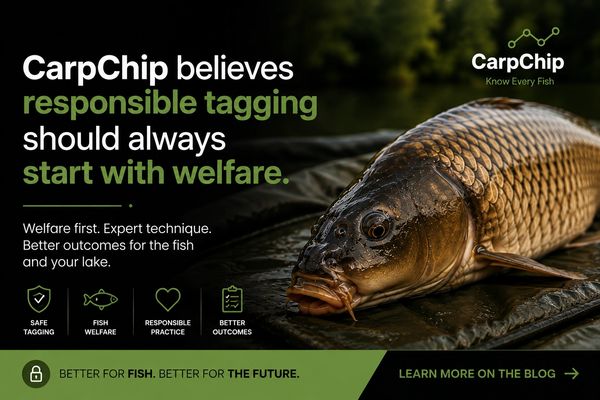
Welfare First
Microchipping your fish should always be carried out responsibly. Correct fish handling, suitable equipment, appropriate tag selection and good implantation technique are important.
CarpChip provides guidance to help commercial fisheries understand the correct approach to carp tagging, scanning and logging of data. The aim is simple: reliable long-term identification while protecting fish welfare.

Build Better Fish Welfare Records
Good fish management relies on understanding what happens to an individual fish over time.
Once a carp has its own ID, future observations can be connected to the correct fish.
That can include:
- Weight changes
- Welfare observations
- Capture frequency
- Growth trends
Rather than keeping isolated notes, the fishery gradually builds a long-term welfare history for each tagged
Track Carp Growth Over Time
Knowing what a carp weighs today is useful.
Knowing that the same carp weighed 34lb two seasons ago, 38lb last year and 42lb today tells you considerably more.
Because the microchip identifies the individual fish, each new weight can be connected to its previous records.
Over time you can begin to see:
- Which carp are growing fastest
- Which strain is performing best
- How recently stocked fish are developing
- How your overall stock is progressing
For commercial fisheries investing heavily in their fish stock, that information can become extremely valuable.
CarpChip: Microchips for Carp Lakes
What Is a Carp Tagging Kit?
A kit to microchip your carp gives a fishery the equipment needed to permanently identify individual carp.
CarpChip uses small passive PIT tags containing a microchip. Each tag carries its own unique electronic identification number.
Once a fish has been appropriately microchipped, a compatible handheld scanner can read that number whenever the carp is caught again.
That unique ID can then be linked to information such as:
- Fish name or reference
- Species & Stocking Information
- Photographs
- Capture dates, Growth history and Weight
- Welfare observations
- Lake records
This gives the fishery a reliable way to identify individual carp rather than relying only on photographs, markings or memory.


What Is a PIT Tag for Fish?
Is Carp Tagging the Same as Microchipping?
In practical terms, the terms are often used to describe the same process. Tags often sit outside the body, at CarpChip we recommend small microchips that are placed under the skin on the fish. This is safe and easy to do, with extensive research backing the process.
With CarpChip, a carp is tagged using a PIT microchip.
The most useful way to think about it is:
Microchipping a carp describes what you are doing.
PIT tagging describes the identification technology.
Microchipping is the familiar way of describing the small electronic chip used to identify the fish.
All three terms refer to the same goal:
Giving an individual carp a reliable electronic identity.
One fish. One permanent ID.
A PIT microchip — Passive Integrated Transponder — is a small electronic identification device used to give a fish a unique ID.
Microchipping fish with PIT tags is widely used in fisheries and fish research where individual fish need to be identified over time.
The microchip does not need its own battery.
When a compatible scanner is passed near the tag, the scanner reads the unique identification number stored within it
Carp Tagging Isn't Just About Theft Prevention
Microchipping valuable carp is often associated with theft prevention.
Microchipping valuable carp is often associated with theft prevention.
Microchipping valuable carp is often associated with theft prevention.
That can be an important reason for tagging.
But permanent identification can provide much more value to a commercial fishery.
Once a fish has a unique ID, every future capture creates an opportunity to add more information to its record.
Over several seasons, you can build a much clearer picture of:
- Growth
- Condition
- Capture frequency
- Stock history
- Fish welfare
- Important individual carp
Identification becomes data.
Data becomes history.
History helps you manage your lake.
Designed for Independent and Commercial Carp Fisheries
You do not need to operate a large aquaculture facility to benefit from microchipping your fish.
CarpChip is designed around the practical needs of commercial carp fisheries and independent lake operators.
From Paper Records to a Living Fish History
Microchipping valuable carp is often associated with theft prevention.
Microchipping valuable carp is often associated with theft prevention.

Many fisheries still keep stock information across a mixture of:
- Paper notebooks
- Spreadsheets
- Photographs
- Social media posts
- Angler reports
- Staff knowledge
- Memory
The problem is that information becomes fragmented.
A permanent fish ID gives you one consistent reference around which the fish's information can be organised.
For fisheries wanting to take this further, CarpChip Lake Tracker connects individual fish IDs with their records, catches, photographs and weight history.
Instead of searching through paperwork, you can build a living digital history for each carp.